


Summary of 7 major problems in evaporative crystallization!
Published Time:
2021-12-14
Source:
Author:
1. How to prevent pipe blockage and scaling in wastewater evaporators?
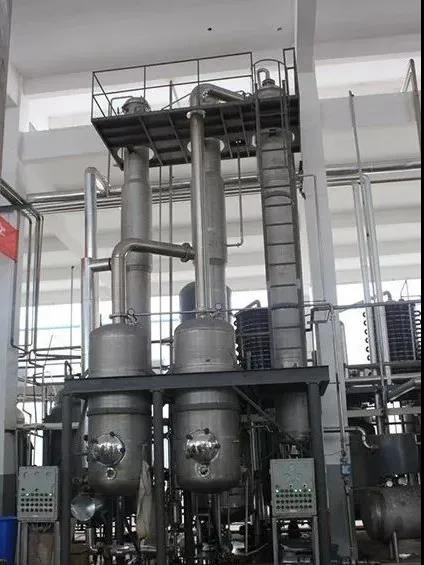
Answer: Pipe blockage generally has two causes: one is the deposition of crystalline salts, and the other is scaling formed by calcium, magnesium ions, etc. Therefore, preventing pipe blockage should also start from these two aspects:
First, choosing the right evaporation method is the first step in preventing pipe blockage. Falling film evaporators and other film evaporators are not suitable for occasions where crystals are produced. If these occasions use falling film or other thin film evaporators, pipe blockage is inevitable. Occasions where crystals are easily produced should use forced circulation evaporators or scraper evaporators, among which forced circulation evaporators have a large evaporation area and are easy to operate.
Second, the setting of the evaporation pipeline is also an important factor in reducing salt. The designed pipeline has no dead corners, conforms to the principle of salt flow and deposition, and ensures that all crystalline salts are collected in the salt collector and discharged from the salt discharger. If scaling is caused by calcium, magnesium ions, etc., the measures that can be taken are:
1. Soften the wastewater to a certain extent to reduce the concentration of calcium and magnesium ions;
2. Use a forced circulation evaporator for wastewater evaporation and crystallization;
3. Use gypsum seeding to prevent scaling or add some antiscalants;
4. Regularly clean the evaporation equipment.
2. Operating cost of the evaporator and how to reduce the operating cost?
Answer: Method 1: Adopt multi-effect evaporation technology. For each additional effect, the operating cost decreases, but the initial investment increases. For wastewater evaporation and salting, it generally does not exceed three effects, at most four effects.
Method 2: TVR (Thermal Vapor Recompression) evaporator can reduce the energy consumption of one effect.
Method 3: Mechanical vapor recompression evaporator greatly reduces operating costs.
Method 4: Do a good job of external insulation of the evaporation equipment to reduce heat loss.
Method 5: Utilization of sensible heat and latent heat of condensate. Use a preheater to recover the sensible heat of the condenser to increase the inlet temperature of the evaporation solution; use a flash evaporation system to recover the latent heat of the condensate.
3. Salt evaporation situation?
Answer: Wastewater evaporation and crystallization Salt evaporation generally has two methods: one is centrifuge salting, which has a low water content; the other is salt discharger with a crystal receiving tank, and the salt is precipitated in crystal form with less external water.
4. Selection of evaporator materials?

Answer: The choice of evaporator material is closely related to the composition of wastewater. For salts, they can be divided into chloride salts (such as sodium chloride and ammonium chloride) and non-chloride salts (sodium sulfate, ammonium sulfate, sodium carbonate, nitrates, etc.).
Chloride salts, in order of corrosion resistance: titanium, duplex stainless steel, carbon steel, ordinary stainless steel
Chloride salts, in order of cost-effectiveness: carbon steel, titanium, duplex stainless steel, ordinary stainless steel
For non-heat exchange equipment, carbon steel enamel, PTFE, and at low temperatures, polypropylene and fiberglass can also be selected.
Non-chloride salts, in order of corrosion resistance: 316L stainless steel, 304 stainless steel, carbon steel
Non-chloride salts, in order of cost-effectiveness: 304 stainless steel or 316L stainless steel, followed by carbon steel. At low temperatures, UPVC, PE polypropylene, and fiberglass can be used.
5. How to choose a suitable evaporator?
Answer: For salt evaporation, forced circulation evaporators are preferred. If the salt concentration is low, a pre-falling film evaporator + forced circulation evaporator can also be used. For other non-salt evaporations, falling film evaporators are preferred.
6. The problem of COD removal rate during evaporation?
Answer: The COD in wastewater is mainly determined by the amount of organic matter in the wastewater. The organic matter in the wastewater may be high-boiling or low-boiling. If it is high-boiling organic matter, it will enter the solid waste and waste liquid system with the salt during evaporation, and the COD of the condensate will decrease; if it is low-boiling organic matter, it will enter the condensate system with the condensate during evaporation, and the COD of the condensate will not decrease. Therefore, the COD removal rate during the evaporation process is related to the specific composition of organic matter in the wastewater. If the owner can provide the specific composition and content of organic matter in the wastewater, the COD removal rate during the evaporation process can be basically judged. The scientific method is still to conduct a small-scale evaporation test to determine the COD removal rate during the evaporation process.
7. Differences between MVR and multi-effect evaporation steam reuse?
Answer: Both MVR and multi-effect evaporation are used to reduce the operating cost of wastewater evaporation. The basic principle of MVR is to recompress the secondary steam to increase the pressure and temperature of the secondary steam, and reuse the secondary steam to heat the heat exchanger to achieve energy saving.
The basic principle of multi-effect evaporation is that the secondary steam enters the next effect evaporator for heating, realizing the reuse of steam. Due to various factors, the number of effects in multi-effect evaporation is often limited. MVR saves more steam consumption than multi-effect evaporation.
Recommended Dynamics


Address: 3rd Floor, Building C15, Phase II, Dongyi International Media Industrial Park, Chaoyang District, Beijing
Email:info@horwater.com

Email:
Tel:
Tel:
图片alt标题设置: Horwater Environment (Beijing) Co., Ltd.
表单验证提示文本: Content cannot be empty!
循环体没有内容时: Sorry,no matching items were found.
CSS / JS 文件放置地